If you've just bought an EV — or you're about to — installing a proper home charger is one of the first things you'll want to sort. But the cost question is harder to Google than it should be.
So here's the straight answer: most homeowners in Hamilton spend $1,450 – $3,700 all up, including the charger and installation. Simple installs at the lower end, more complex setups at the higher end.
What puts you at one end of that range or the other? That's what this guide is for.
What you're actually paying for
There are two costs: the charger itself, and the installation labour.
Item | Typical Cost | |
|---|---|---|
EV Charger (Hardware) | $1,000 - $2,500 | |
Installation (Labour) | $450 - $1,200 | |
Total Install cost | $1,450 - $3,700 |
Most installs land in the middle of that range. The extremes - very cheap or very expensive - are less common and usually explained by one of the factors below.
What Actually Drives the Cost?
This is where most people underestimate things.
Distance from your switchboard
This is the single biggest variable. The further your charger needs to be from your switchboard, the more cabling and labour is involved. A garage on the other side of the house costs more than a carport next to the meter box. If there's trenching involved — say, running cable underground to a detached garage — expect that to add significantly to the bill.
Your switchboard capacity
Older homes sometimes need an upgrade before an EV charger can be added. If your board has the capacity, you're fine. If not, budget an extra $800 – $1,500 for the upgrade. A good electrician will check this at the quote stage and tell you upfront.
The charger itself
There are two main options:
Slow (Mode 2) charger — this is the cable that comes with most EVs. You plug it into a standard wall socket. It works, but it's slow — typically 10–15 hours for a full charge. Fine as a backup, not ideal as your main setup.
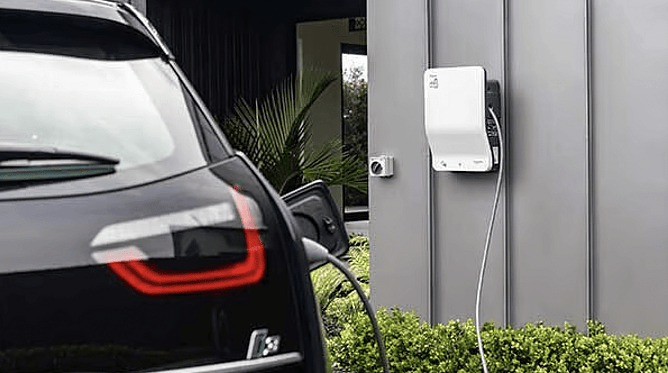
Smart wall charger (Mode 3) — this is what most people install. It's faster (a full charge overnight), usually has app control and scheduling, and is a much better long-term setup. These units typically cost $1,000 – $2,500 for the hardware, plus installation.
For most homeowners, a smart wall charger is the right call. The extra cost pays for itself quickly in convenience and charging speed.
Installation complexity
Beyond cable distance, costs increase if the install involves outdoor mounting on a difficult surface, brick or concrete drilling, or any non-standard electrical work. Your electrician should walk you through this at the quote stage — there shouldn't be surprises.
Real-world cost scenarios
Simple install — charger close to switchboard, no upgrades needed, straightforward cable run. Typical cost: $1,500 – $2,500
Standard install — moderate cable run, minor electrical work, wall-mounted smart charger. Typical cost: $2,000 – $3,500
Complex install — switchboard upgrade required, long cable run or trenching to detached garage. Typical cost: $3,500 – $5,000+
Is it worth it?
For most homeowners, yes — and the maths is fairly compelling.
Charging at home overnight typically costs $3 – $5 for a full charge, depending on your electricity plan and the size of your battery. Compared to petrol, that's roughly equivalent to paying $1.50 – $2.00 per litre. With fuel prices where they are, the running cost savings are real.
Beyond cost: no waiting at public chargers, charge overnight while you sleep, and your car is always ready in the morning. Once you've had a home charger for a month, it's hard to imagine not having one.
EV charging and solar
This is where a lot of Hamilton homeowners are heading, and it's one of the fastest-growing enquiry types electricians are seeing right now.
If you already have solar panels — or you're planning to get them — you can pair them with a smart EV charger like the Zappi, which prioritises your own solar generation before drawing from the grid. On a good day, you're effectively charging your car for free.
The combination of solar + EV charger is increasingly common in NZ, and it makes the economics even stronger. If you're considering both, it's worth talking to your electrician about doing them together — the planning and some of the wiring overlap.
Financing options
An EV charger installation is the kind of home upgrade that some banks and lenders will finance at low or zero interest, particularly when bundled with other energy efficiency improvements like solar or insulation.
It's worth checking with your bank what's available — the right financing can turn a $2,500 install into something much more manageable month to month.
The mistake most people make
The most common mistake is choosing an installer based on price alone.
A cheap quote can mean corners cut on cable routing, a charger positioned in a less-than-ideal spot, or wiring that isn't future-proofed. When you add a second EV or upgrade your charger later, you end up paying to redo work that should have been done right the first time.
A good installer will assess your home properly, recommend the right charger for your car and setup, and position everything with the long view in mind. The difference in cost between a cheap job and a good job is usually a few hundred dollars. The difference in outcome can be a lot more.
What to expect when you get a quote
Every home is different, which is why a site assessment is the right first step. A proper quote should cover:
The right charger for your car and budget
Switchboard assessment (do you need an upgrade?)
Best cable route and charger position
Exact pricing, no surprises
If you're based in the Waikato and want to get your install sorted, get in touch and we'll come out, assess your setup, and give you a straight answer on cost and timing.

